Design Methods · Studio workbook
Working sheets
Keep the trail from your first sketch to the decision you can defend. Each sheet has a worked example, space for your own evidence, and a link to the method behind the exercise.
Your project draft
Write on this device. Download a backup to continue in a different browser or share a copy with your team. Add filenames or links for images and recordings, and keep those files alongside the backup. The text export is a working draft for your final, edited process PDF.
Your entries stay in this browser. Download a backup at the end of each session.
Break an ordinary rule
Discover a design question by changing the relationship between a person and an object.
In the studio · Watch Tarati and sketch the gesture from memory. Identify the normal expectation that the concept disturbs. Choose an everyday object of your own. Generate three variants with AI. Keep the situation, scale and actor constant; change a single rule per variant. Keep a rejected image.
Leave with · A three-variant contact sheet, a complete prompt record, one rejected result and a question for fieldwork.
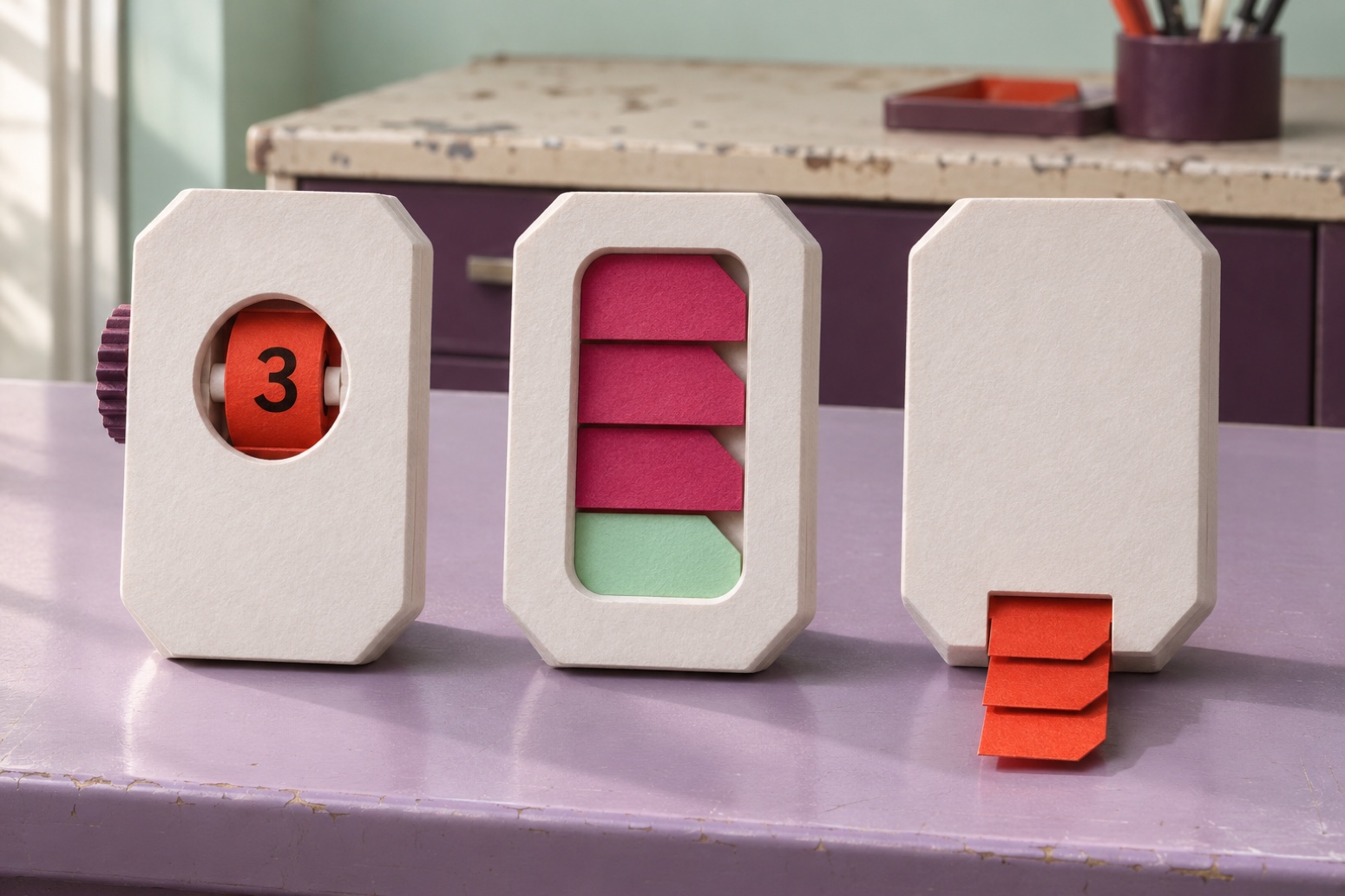
Read a worked example
- Historical object
- Tarati, NONOBJECT project video. A finger approaches the openings. What feedback would tell a first-time visitor that an input was registered?
- Original brief and prompt
- Base: “Design a palm-sized ticket for a workshop queue. Show one visitor holding it at the entrance. Render an ordinary, reusable object in a single clear view.” Record the actual tool name, date and image files at generation time.
- Three changed rules
- A shows only arrivals behind the holder. B reveals its number only to a neighbour. C displays a count only after a visitor gives up their place. Each changes one information rule.
- Selection and limits
- Choose A: a growing count looks like progress while saying nothing about a turn. Reject C because exchanging places changes the entire service. The rendered display offers no evidence about real visitors.
Name the object and source. Describe what is visible, what you infer and an unanswered question.
Log the tool/model as displayed, date, full prompt, settings or seed if available, and file IDs. Include what you held constant.
For A, B and C enter the exact prompt change, result ID and what people could or could not tell from the image.
Annotate your chosen and rejected outputs. Which relationship deserves research? Which detail did the image invent?
Enter an anonymous evidence ID, a filename or URL, and a short caption. Keep your original files separately.
Frame, impact and audience
Turn the speculative object into an open design challenge.
In the studio · Work through the original sequence: Frame Your Design Challenge, Align on Your Impact Goals (Impact Ladder), then Define Your Audience (Ecosystem Mapping). Add secondary research and a small project plan.
Leave with · Opening three worksheets, a source note and a feasible fieldwork plan.
Original IDEO.org materials
Read a worked example
- 1 · Frame Your Design Challenge
- How might first-time workshop visitors tell whether they have been seen while waiting? A greeting and a paper signal could both answer it.
- 2 · Align on Your Impact Goals
- First: visitors can locate the check-in point. Later: fewer unnecessary repeat check-ins. Observe the first action, then ask what they thought it achieved.
- 3 · Define Your Audience
- New visitor → helper → technician. The helper covers the queue while fetching tools. Ask both visitor and helper how a handoff works.
- Secondary research and project plan
- Review the posted arrival instructions; they identify a desk but do not show what happens when it is empty. Compare the instructions with an observed opening shift.
Write the underlying problem, context, constraints and two substantially different possible responses. Original worksheet · Frame Your Design Challenge
Connect a feasible immediate change to a longer-term effect. Write down what you can actually observe this semester. Original worksheet · Impact Ladder
Map who experiences the situation, who maintains it and whose perspective is missing. Mark one relationship. Original worksheet · Ecosystem Mapping
Record a named source, one finding, one limitation, and who will collect which evidence by when.
Enter an anonymous evidence ID, a filename or URL, and a short caption. Keep your original files separately.
Collect first-hand evidence
Keep an encounter traceable from raw note to a tentative interpretation.
In the studio · Interview someone about their last visit. Pair this with a guided tour or another justified Inspiration method. Ask permission to take notes and offer to stop. Record participants using anonymous IDs.
Leave with · An interview guide, a field record, one discrepancy and a research decision.
Original IDEO.org materials
Read a worked example
- Method and rationale
- Use a tour to see where a pause happened. A retrospective interview alone may miss the obstructed sightline.
- Interview framework
- “Take me through the last time you came in.” “What happened next?” “Where were you standing?” Follow-up: “What led you to that impression?”
- Record and interpretation
- Illustrative record R1: visitor looks back at the door, then asks the helper. Hypothesis: they were unsure whether to wait. Other possibility: they were looking for someone.
- Decide what to collect next
- Ask a first-time visitor who stayed at the desk. Look for a second reason for remaining there.
Which question justifies the method and whom will you involve?
Write three open questions and a non-leading follow-up. Interview Guide · blank worksheet (Field Guide p. 166)
Keep event, words, tentative explanation and evidence ID separate.
Which account is missing? What would cause you to revise this interpretation?
Enter an anonymous evidence ID, a filename or URL, and a short caption. Keep your original files separately.
From stories to an opportunity
Translate field evidence into a question that admits more than one design.
In the studio · Share an episode in the participant’s terms. Use Top Five and Find Themes to compare stories, write an insight, then generate three How Might We questions. Keep an exception visible.
Leave with · Story cards, a named theme, an insight and one HMW question linked to evidence.
Original IDEO.org materials
Read a worked example
- Story and evidence
- Teaching example R1: a visitor checks the doorway twice while waiting; R2: another asks a helper and then waits elsewhere.
- Top Five and theme
- Theme: visitors look for acknowledgement. Exception: a returning visitor recognises a staff member without needing a sign.
- Insight and warrant
- People may need confirmation that someone knows they are waiting. Two examples justify investigating this explanation; they do not establish its frequency.
- Reframe and select
- How might a first-time visitor recognise a handoff? This leaves open a spatial cue, a conversation or a physical object.
Give the episode an ID. What happened, where, and what detail challenged you?
List important episodes, group them and keep the odd case visible.
What pattern could explain the evidence? Which part is an inference? Original worksheet · Insights Checklist
Write three HMWs. Keep the most useful one and explain the discarded alternatives. How Might We · blank worksheet (Field Guide p. 177)
Enter an anonymous evidence ID, a filename or URL, and a short caption. Keep your original files separately.
Generate and choose a concept
Produce alternatives that differ in behaviour, then choose on stated grounds.
In the studio · Brainstorm individually before discussion. Bundle similar ideas, draw three distinct concepts and decide which uncertainty to test first.
Leave with · An annotated set of alternatives, choice criteria and a rejected direction.
Original IDEO.org materials
Read a worked example
- Constraint and alternatives
- Same doorway and staffing. A visible desk flag; a visitor-held receipt; a spoken handoff between helpers.
- Bundles
- A flag broadcasts a state. A receipt confirms one person’s status. A handoff transfers responsibility.
- Decision
- Test a handoff and a flag because each can be staged without software. Defer the receipt until a visitor can explain where to retain it.
- Additional methods
- Use a role-play to expose what happens when the helper leaves the room. Record which part of the concept now needs a fallback.
What is fixed? Describe three mechanisms, including a social or low-tech alternative.
Name the principle behind each group. What would the visitor do differently?
Choose criteria and compare the alternatives. Show why a losing option was plausible.
Name an additional Ideation method you selected, why you chose it and an observable result.
Enter an anonymous evidence ID, a filename or URL, and a short caption. Keep your original files separately.
Map the journey and stage it
Find the point where a journey breaks and turn it into an enactable scene.
In the studio · Work from the Journey Map to Create a Concept, then Storyboard the user journey. Add a Relational Map if a handoff between people needs more detail. Role-play a version with and without a helper.
Leave with · A journey map, concept and 3–6 storyboard frames plus an annotation from the enactment.
Original IDEO.org materials
Read a worked example
- Journey
- Approach → stop at desk → wait → hear call. At “wait”, the helper leaves and the visitor has no clear contact.
- Concept
- A reusable desk flag tells arrivals who currently holds responsibility for the queue.
- Storyboard
- A: workshop entry. B: visitor sees flag. C: helper passes flagged board to colleague. D: visitor sees where to ask.
- Rehearsal
- The seated visitor could not see the flag over an easel. Move it into the approach sightline for the next prototype.
For each moment name action, actor, evidence and friction. Journey Map · instructions and diagram (Field Guide pp. 90–91)
Write one sentence explaining what changes for whom.
Draw or reference frames for the trigger, response, handoff and recovery. Storyboard · blank template (Field Guide p. 178)
Who played which role? Which frame failed, and what will you change?
Enter an anonymous evidence ID, a filename or URL, and a short caption. Keep your original files separately.
Prototype the uncertain detail
Choose the cheapest material that can answer one design question.
In the studio · Use paper or enactment to test one uncertainty at full scale. Analyse the cue with Don Norman. Preserve the earlier state.
Leave with · One runnable prototype, an annotated still and a prediction that could be wrong.
Original IDEO.org materials
Read a worked example
- Question and fidelity
- Can a visitor distinguish where to wait from where to ask? Hand-lettered signs are sufficient if the position is realistic.
- Norman analysis
- The visitor can approach either desk. The flag marks the active desk; the helper’s acknowledgement confirms the handoff.
- Versions
- V1 flag sits between desks. V2 flag sits on the active desk. Preserve wording and colour.
- Prediction and trial
- Predict the first approach goes to the flagged desk. A visitor who asks at the unflagged desk calls the mapping into question.
Name the uncertainty; choose what must work and what may be simulated. Original worksheet · Prototype Mapping
What can someone do? What signifies it? How does the cue map to the intended target, and what feedback follows?
Describe or reference V1 and V2. Name the single changed variable.
Specify an action, success signal and plausible contrary observation. Original worksheet · Prototype Report Card
Enter an anonymous evidence ID, a filename or URL, and a short caption. Keep your original files separately.
Inspect, then observe
Keep heuristic findings separate from behaviours actually observed.
In the studio · Inspect the design using Nielsen’s visibility of system status, user control and freedom, and error prevention. Turn one predicted issue into a neutral test task. Ask a fresh participant to try it.
Leave with · An inspection note, test task, observation and revised priority.
Original IDEO.org materials
Read a worked example
- Inspection
- Visibility: flag disappears when the host takes a break. Predict a visitor may check in twice.
- Task
- “You arrive while your partner is still fetching materials. Show me how you would join the workshop.” Wait for a request or explicit abandonment.
- Observation
- Illustrative: B reads the flag, waits and asks “Am I on the list?” This reveals a question about acknowledgement; they did not check in twice.
- Revision
- Test explicit acknowledgement before making the flag larger. The visitor may have been unsure about the list itself.
Record the heuristic, location, potential problem and a prediction.
State a goal without naming a control. Describe when you will intervene.
Write actions/words first. Mark assistance or uncertainty.
What changed in your design decision? Which alternative explanation remains?
Enter an anonymous evidence ID, a filename or URL, and a short caption. Keep your original files separately.
Iterate and define success
Translate a finding into a design change and a testable indicator.
In the studio · Compare two versions, choose an indicator and plan a small rehearsal. Distinguish a short class trial from a longer service pilot.
Leave with · Version comparison, indicator, baseline, stopping rule and follow-up plan.
Original IDEO.org materials
Read a worked example
- What changed
- Add an acknowledgement step while keeping the arrival route unchanged.
- Indicator
- Count unprompted first approaches to the duty desk / arrivals observed; annotate interruptions. This measures route finding only.
- Trial limits
- Rehearse at a marked-out desk with classmates before a real opening. This does not establish effectiveness across a semester.
- Decision threshold
- Stop a trial if people believe the prototype records a real booking. Clarify the context and repeat the task.
Which observation motivated the revision? What stays constant?
Define a unit, denominator, collection point and limitation. Original worksheet · Indicators Mad Libs
Describe location, recruitment, roles and limits of the trial.
What result means revise, repeat or stop?
Enter an anonymous evidence ID, a filename or URL, and a short caption. Keep your original files separately.
Plan delivery and pitch
Explain the design, its evidence and the work somebody must own.
In the studio · Make a Roadmap, identify resources and staffing, define success and create a pitch. Revisit the Design Council’s two diamonds and show a point where you returned to an earlier question.
Leave with · A single-page implementation plan and a short pitch backed by prototype evidence.
Original IDEO.org materials
Read a worked example
- Roadmap and owner
- Technician approves trial position → helper rehearses handoffs → lecturer reviews anonymised observations.
- Resources and staffing
- Two flags, tape, one greeting helper, one observer. A named shift substitute resets the flag.
- Success and revision
- Reopen Develop when the high-mounted cue is missed. Plan a longer trial only after the flag can be used across shifts.
- Pitch
- Lead with the visitor waiting beside the wrong desk. Show the moved flag, describe the trial, then ask for one supported shift to test the handoff.
List three steps in dependency order, with a responsible person and decision gate.
Name equipment, time, roles and what happens when someone is absent. Resource Assessment Matrix · companion worksheet (Field Guide pp. 182–183)
Which result would warrant running a pilot? Where did you reopen a design question? Original worksheet · Indicators Mad Libs
Write the opening scene, decision, evidence, limitation and ask. Create a Pitch · blank worksheet (Field Guide p. 185)
Enter an anonymous evidence ID, a filename or URL, and a short caption. Keep your original files separately.
Run a live rehearsal
Observe what changes when an intervention meets the place and people it is for.
In the studio · Install or stage the intervention, assign host/participant/observer roles, run short trials, reset predictably and keep a contemporaneous record.
Leave with · Setup diagram, anonymised trial log, before/after record and decision for the retest.
Original IDEO.org materials
Read a worked example
- Set-up and roles
- Mark the doorway and assistant’s desk. Reset the flag and seating before each arrival.
- Trial record
- Illustrative T1 / V1 / A: reached the wrong desk, asked for help. Record precise position before adjusting anything.
- Revision
- Move the flag onto the desk edge. From behind, the sign might now be invisible.
- Next trial
- Ask a new visitor to approach from the opposite corridor with the same goal.
Sketch the starting position, record version, identify who resets it and how trials end.
For each attempt note version, task, participant code, first action, outcome and assistance.
Write one change, its rationale and the uncertainty it introduces.
Which participant or route would be most revealing next?
Enter an anonymous evidence ID, a filename or URL, and a short caption. Keep your original files separately.
Retest, exhibit and reflect
Make the progression from speculative idea to evidence and design decisions visible.
In the studio · Retest one unresolved issue, present the prototype and assemble the process PDF. Include two additional Inspiration methods and two additional Ideation methods with independent rationales, then reflect in five to ten sentences.
Leave with · One coherent process PDF, demo/pitch and credit record for sources, collaborators and AI.
Original IDEO.org materials
Read a worked example
- Compare
- Record whether the new visitor reaches the duty desk. Prior workshop experience may also influence the route.
- Evidence index
- Example chain: R1 → HMW2 → storyboard frame C → V2 → T2 → decision. Add the four self-selected methods with why and outcome.
- Authorship and AI
- The speculative ticket image generated the research question. Field notes and trial records support the design decision.
- Reflection
- Sentence starters: I initially assumed… An observation challenged that because… The redesign made… I still cannot tell… My next test would…
Use the same task and describe what changed between versions. What could also explain it? Original worksheet · M&E Framework
Link challenge, field records, extra methods, insights, map/storyboard, prototype versions and implementation/pitch to pages or asset IDs.
Credit original course sources, actual tool/version, prompts and variants; identify edits and real field evidence separately.
Write 5–10 sentences about a change of mind, the evidence behind it, a limitation and what you would do next.
Enter an anonymous evidence ID, a filename or URL, and a short caption. Keep your original files separately.
Original Field Guide
These are course adaptations with examples written for this studio. IDEO.org offers its own Field Guide, method instructions and worksheets.