Input
What is a ticket allowed to tell you?
An ordinary queue ticket makes a promise about your place. Changing what it reveals can change how waiting feels.
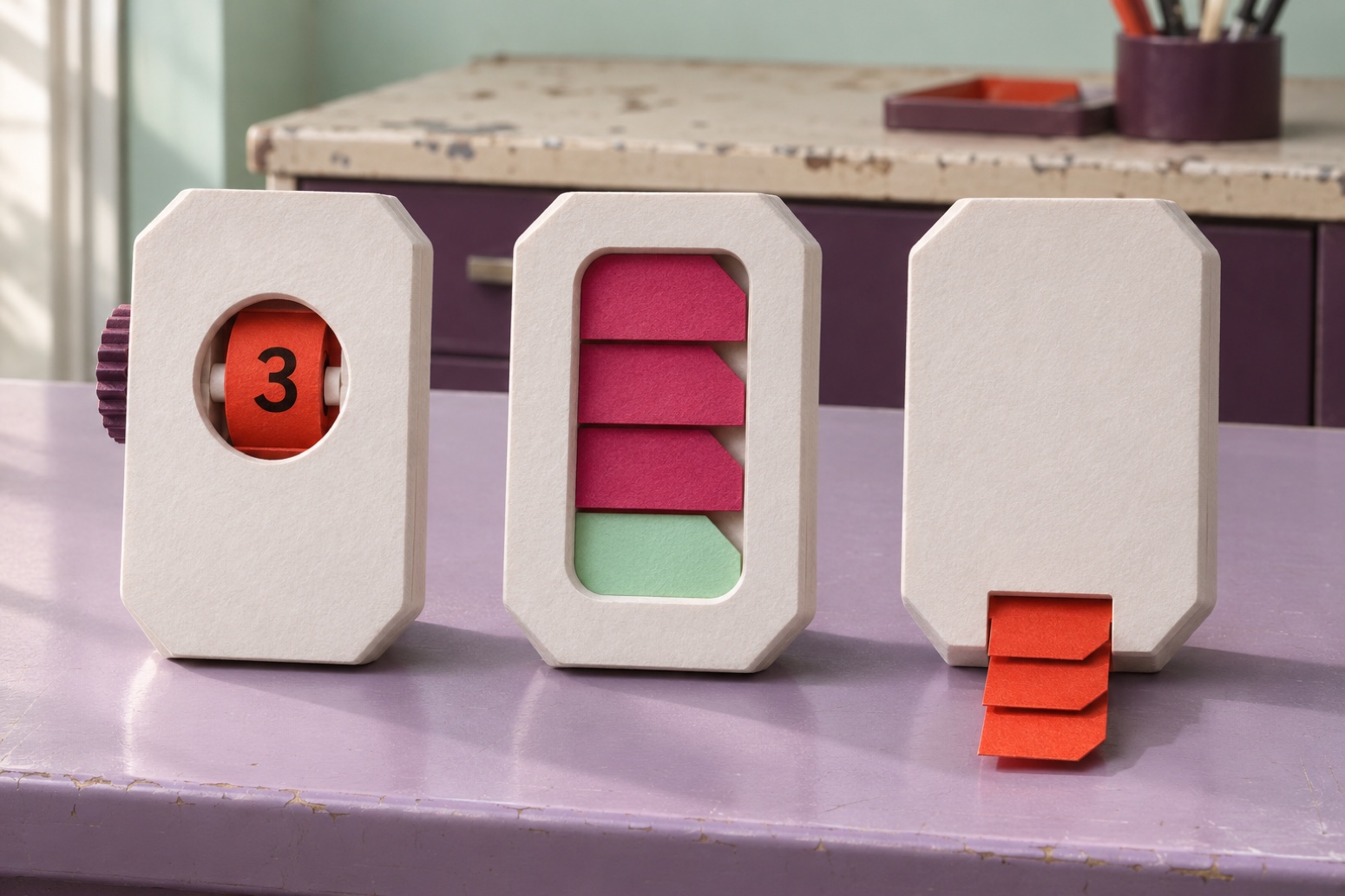
The setting
One shared campus workshop, one host and a first-time visitor with ten minutes to spare.
Today’s outcome
Read a published concept. Develop three original rules and choose a question worth investigating.
Demo
Tarati changes the gesture
NONOBJECT’s Tarati is a speculative phone in which a finger passes through an opening to dial.
Source
Branko Lukić and Barry M. Katz, NONOBJECT, MIT Press, 2010. Case film: Tarati.
First viewing
Trace the hand. Where does it begin, what does it approach and where does it end?
Second viewing
Which familiar telephone gesture has been changed? Which part of the task remains recognisable?
Input
Read an object in three passes
A close reading names an expectation, identifies the changed rule and traces a consequence for somebody.
Expectation
In a familiar keypad, a finger meets a surface at the chosen number.
Intervention
The proposed dialling action takes place through an opening.
Consequence to investigate
What would let a person know that their digit had registered?
Studio
Make a trace another person can read
Draw the caller’s action in three frames and attach one unanswered question to a specific frame.
W01 · Work alone
Three frames: reaching, passing through, expecting a response.
Exchange
A partner retells the gesture. Underline the first thing they had to invent.
Demo
Move the method to the workshop door
A counterfactual changes one rule of an ordinary relationship. Set the ordinary situation first.
Earlier course prompt studies
Stefan Kainbacher, 30 April 2026: a fork with extremely short tines and a paper-thin phone that is hard to grasp.
Workshop fixture
Same host, visitor, doorway and ten-minute interval. The reference ticket reports the people still ahead.
One reversal
The new ticket reports only how many people have arrived after its holder.
Input
Hold the scene still while you change the rule
Make three propositions comparable by changing the information the ticket reveals while holding its context fixed.
A · Later arrivals
Count everyone who joins after this visitor. The count can only rise.
B · Visits to the door
Count the times the host comes to the threshold after this ticket is issued.
C · Silence
Show whole minutes since the host last gave the room a public update.
Studio
Write three rules before opening a generator
Author the behaviour first. A sketch and an event trace make a rule easier to test than a product name.
Sixteen minutes
3 min fix the case, 8 min write three rules, 5 min compare the traces.
Evidence
For each rule, record one trigger, what changes on the ticket and which decision the holder still cannot make.
Discussion
Could you tell which rule was running?
A cold read tests whether a rule is specific enough for somebody else to enact.
Play the host
Read the same events to a partner and let them update the three displays.
Find the ambiguity
If two interpretations are possible, rewrite the rule and preserve the earlier wording.
Break
Break
Return in fifteen minutes with the three rules, the common scene and one disputed event.
Leave open
W01 with your pre-generation sketches and original rules.
On return
We will turn one ambiguity into a constraint in the prompt.
Demo
Write a prompt that can fail
Ask for at least three new concept rules under fixed conditions. Save the exact prompt, the outputs and your decisions.
Prompt fixture
One shared workshop door, host and first-time visitor. Same ticket and ten-minute event list.
Requested output
Propose three different disclosure rules. For each give its trigger, two successive display values and what the visitor still cannot learn.
Reject if
An option adds staff, changes the queue policy, copies Tarati’s form or supplies unsupported claims about real visitors.
Studio
Generate, then test the three replies
Use AI to generate at least three original candidate variants for your case. Keep a trace of what you accept, reject and rewrite.
Run
Save the prompt, tool, date and original responses. Label a teacher-run or provided run accurately.
Inspect
For every response, run two of the same events through it. Annotate the first unsupported or ambiguous step.
Revise
Ask one targeted follow-up or rewrite one rule yourself. Mark who made each change.
Studio
Build a paper proof of your strangest rule
A simple performance makes a speculative relationship visible and exposes features that the prompt silently assumed.
Props
Ticket face, event slips, host/visitor role labels and a blank state for the start.
Run twice
Start with the same state. Replay once with an ordinary event and once with a difficult event.
Keep
Photograph or draw the two moments and identify one decision the visitor still faces.
Discussion
Which question could survive the disappearance of the ticket?
Move from a speculative object to a question about a real situation that could produce several kinds of design.
Object question
Would people buy a ticket that counts later arrivals?
Researchable question
How do newcomers decide whether to wait, ask a host or leave when the next step is unclear?
Counterexample to look for
A visitor leaves quickly because the purpose of their visit is already complete.
Studio
Leave with an artefact and a field question
Assemble the W01 record so another designer can reconstruct the choice you made and the evidence you still need.
Case → concepts
Cite Tarati. Preserve the fixed scene, three self-authored variants and the prompt with at least three generated candidates.
Decision → question
Show the rejection or revision, two states of the chosen proposal and a question to take into the field.
Discussion
What can the ticket tell its holder?
A speculative ticket counts the people who arrived after you. Its display now reads 04.
Read the number
What event would make it change to 05?
Read the situation
What decision might you still be unable to make?
Input
Where are we in the Double Diamond?
We can choose a place to look before we know what the eventual design challenge will be.
Discover → Define
Expand the possible accounts. Use material from the field to choose a meaningful challenge.
Develop → Deliver
Explore different responses. Try them on a small scale and revise them.
Today's decision
Choose a situation in which the first framing could change.
Demo
How wide should the challenge be?
Start with Frame Your Design Challenge, the first original worksheet. Try three versions of one brief.
Object
How might we redesign a ticket that counts later arrivals?
Situation
How might people decide what to do next when they arrive at an unfamiliar workshop?
Ambition
How might everyone get fair access to shared facilities?
Studio
Make two competing versions
Use one ordinary decision from your own example. Keep the first draft visible.
Draft twice
Change one boundary, such as actor, moment, location or consequence.
Test both
Name possible responses and a field encounter for each.
Retain a reason
Choose a working version. Save one reason you could reopen it.
Input
Build an Impact Ladder
Use the Impact Ladder in Align on Your Impact Goals, the second original worksheet, to agree on a near-term outcome and long-term impact.
Long-term impact
People with different levels of workshop experience can participate on fair terms.
Near-term outcome
A newcomer can choose a next step and explain what informed the choice.
Open assumption
Knowing the options would help at least some people act. Who could challenge that?
Demo
Whose account could change this question?
Use the Ecosystem Mapping worksheet in Define Your Audience to trace who shapes a decision.
Directly involved
A first-time visitor chooses whether to enter or wait.
Shapes the conditions
A technician allocates equipment. A returning visitor explains an informal routine.
Missing perspective
Someone who turned away may be absent from the very place we planned to visit.
Studio
Choose whom to hear first
Connect a hoped-for change, a missing perspective and a question you could ask.
4 minutes
Write two rungs and one assumption in the space between them.
7 minutes
Map one directly affected person, one person who shapes the situation and one absent voice.
7 minutes
Choose a first encounter, a practical invitation route and one consequence of that choice.
Input
What can a document establish?
Secondary research gives a field question a history, a vocabulary and limits.
Find the document
Who published it, when, for whom and for which site or event?
Bound the claim
Write one sentence that fits what the source actually covers.
Name the gap
Which local practice or experience still needs investigation?
Break
Break
Return in fifteen minutes with your audience map, your near-term outcome and one claim to check.
Pause
Step away from the screen.
Return
Bring your draft claim and the source you will check.
Demo
Watch one claim get smaller
Compare a dated event notice with the official contact page for the Green FabLab.
2020 event notice
A programme announcement directed prospective attendees to registration information.
Contact page
The institution lists a visitor address and a separate postal address.
Field question
How does a first-time visitor work out which entrance to use?
Studio
Run a nineteen-minute source audit
Produce two short source records someone else could check.
0–6 minutes
Choose a claim. Find the original publisher and another source with a different purpose.
6–14 minutes
Record title, publisher, date or undated, link, precise claim and limit.
14–19 minutes
Exchange records. Trace one claim back to the page and write the unresolved question.
Discussion
Which inference survives the audit?
Read one precise sentence, its source and one remaining uncertainty.
Author
Show where a reader can check the sentence.
Reader
Identify a word that reaches beyond the document.
Group
Edit that word and formulate the resulting field question.
Discussion
Can one encounter answer it?
Turn a design challenge into a field question that asks about an actual episode.
Design challenge
How might newcomers choose a next step at an unfamiliar workshop?
Field question
What did a newcomer use to decide what to do during their most recent arrival?
Opening prompt
Talk me through that arrival, starting just before you reached the door.
Studio
Build and rehearse the field plan
Give one question a place, a participant, a method, a record and a fallback.
0–7 minutes
Name the question, encounter, access route, researcher and time window.
7–17 minutes
Rehearse the invitation and opening. Decide what to note and what permission you need.
17–25 minutes
Write a fallback and a finding that would make the team revise its frame.
Discussion
Hand your plan to another pair
A peer should be able to locate the uncertainty and carry out the first step.
Read back
What will the team learn, from whom and under which conditions?
Challenge
Which answer would make the team redraw its scope?
Leave with W02
Save the challenge, source records, ladder, audience choice and one field plan.
Discussion
What can a ticket tell its holder?
A workshop ticket shows how many people arrived after you. You are deciding whether you have time to fetch your materials.
Read the number
Two people arrived after you. What can you establish from that?
Compare decisions
What information would change whether you stayed by the door?
Open W03
Keep one question about the waiting situation open.
Input
Ask for a particular occasion
An interview can recover the order of remembered events, the choices somebody recalls and the cues they remember using.
Open
“Tell me about the last time you arrived somewhere and had to decide where to wait.”
Follow the event
“What happened just before that? What did you do next?”
Check a term
“You called it your turn. What told you it had begun?”
Input
Agree what may be recorded and shared
The person chooses whether to participate, which part of an experience to show and which details may enter the class record.
Explain the invitation
Give the topic, duration, audience and note-taking plan. Offer an observer role or an invented scene.
Ask separately
May we take written notes? May we read back a short line for the class?
Respect the boundary
Pause on request. Close personal screens and use a blank sketch for places outside the agreed route.
Demo
Listen for the first change of plan
Invented demonstration. A visitor waits with a sheet of material and moves when a second bench becomes visible.
Begin with the episode
“Where were you when you first needed to make a decision?”
Pick up their words
“You said ‘in the way.’ What happened just before you moved?”
Read back a line
Check the wording and ask permission to keep the short excerpt.
Demo
Let the guide choose the route
Invented tour. The guide arranges a door, a bench and a service point on a sheet of paper.
Invite a route
“Choose where our tour should begin. Show me where you go next.”
Pause at a decision
“What can you pick up from here? Could you show me what changes over there?”
Mark the setting
A desk reconstruction records what the guide demonstrated in class.
Studio
Repair three questions
Write a small question guide your group can use even if the person has never visited this workshop.
Remove the proposed fix
“Would a countdown help?” → Ask about a time when the next step was unclear.
Remove the judgement
“Were you frustrated?” → Ask what happened and what they did.
Make room to show
Add one invitation to demonstrate a movement, object or change of viewpoint.
Studio
Calibrate your field notes
Invented scene. Separate what a person said, what a note-taker saw and what the team thinks might explain it.
Quote or paraphrase
Quotation marks require exact words. Label a remembered gist as a paraphrase.
Observation
Describe a visible action and its setting, including whether the scene was reconstructed.
Interpretation
Attach a possible reading to a note ID and name a competing explanation.
Break
Break
Return after fifteen minutes. Close or cover working notes before leaving the table.
Pause
Leave draft notes with their note-taker.
Return
Bring W03, a pen and three small objects or paper cards.
Input
Keep a usable line without identifying the person
A classroom field note needs enough context to interpret the line and little enough detail to protect the person who gave it.
Remove the identifying combination
A unique role, rare project and exact time may identify someone even without a name.
Keep a checked excerpt
Use a short, continuous excerpt that can stand on its own, with permission.
Change the form if needed
Use a labelled paraphrase, or leave the line out if the person or situation remains recognisable.
Studio
Run three seven-minute interviews
Work in triads. Each person interviews once, tells a chosen episode once and takes notes once.
Minutes 0–2
Choose roles and assign a source code. A role-play gets a simulation label.
Three rounds of seven
Invite and agree scope for 1 minute, follow the episode for 4, read back for 2. Rotate roles.
Last two minutes
Highlight a checked excerpt or paraphrase and mark the permission for class sharing.
Studio
Follow one decision through a guided tour
The guide chooses the route, the level of detail and whether to work from a sketch, a model or an accessible agreed location.
Set the scene
Choose a safe, permitted section of a route or draw one from memory.
Rotate through three stops
Per round, guide for 2 minutes, explore one decision for 2, confirm a note for 1.
Capture the distinction
Record one observed gesture or action, a reported explanation and where each occurred.
Studio
Edit one field record for a class reader
Assemble a compact W03 record that preserves source, permission, evidence type and an open question.
Header
Add a source code, broad context, method, setting and agreed sharing scope.
Evidence lines
Keep one checked quote or labelled paraphrase and one observable detail, each with an ID.
Interpretation
Link a tentative reading to the lines. Add an alternative and a question that could distinguish them.
Discussion
Can another group recover the evidence?
Exchange only the reviewed record. Ask a reader to reconstruct the event and challenge the team’s interpretation.
Read it cold
Identify what happened, where the record came from and the strongest uncertainty.
Challenge a reading
Offer a second plausible explanation for the same evidence.
Return a precise edit
Underline the first phrase whose evidence type or sharing scope you cannot determine.
Studio
Hand over the question that remains
Finish W03 with one traceable record and a question a later research visit could answer.
Revise
Clarify the evidence type or setting flagged by the reader.
Carry forward
Write a follow-up tied to an evidence ID. Identify who could answer or what you could observe.
Submit
Share only the approved de-identified field note, with the real, analogous or invented source identified.
Discussion
What can this ticket tell you?
Hypothetical teaching case • Shared campus workshop. Your ticket reads ‘4 people have arrived after you.’
Write privately
You need to collect material upstairs. What do you know? What decision is still open?
Pair comparison
Name one fact on the ticket and one assumption you made. Keep both for W04.
Input
Open the hypothetical research packet
Training evidence only. A–D are separate invented episodes. N1–N8 are the permanent note IDs within them.
A · N1–N2
N1 observation: holder A looked at ‘4 after you’, picked up a bag, then set it down. N2 invented quote: ‘If I get the sheet upstairs, who hears my name?’
B · N3–N4
N3 observation: B gave another visitor a sketch and walked upstairs. N4 invented quote from B: ‘They'll wave when the tutor comes.’
C and D · N5–N8
N5: C read ‘2 after you’ and kept sanding. N6 quote: ‘I've got work right here.’ N7: tutor checked the marked bench before calling D. N8 quote from D: ‘I didn't know they checked the bench first.’
Demo
Tell one encounter twice
Share Inspiring Stories • Keep the people, setting, sequence and source visible while another person takes notes.
First telling
‘A was frustrated by an inaccurate queue estimate.’ Find every word this packet cannot support.
Second telling
A read ‘4 after you’, raised and lowered a bag, and asked who would hear their name upstairs. The observer stopped there.
Listener's capture
A/N1 action • A/N2 words • I: leaving might make a call easy to miss • ? what happens if a call is missed?
Studio
Story circle with a return ticket
In rooms of three, rotate storyteller, listener and source checker. Use a permission-cleared account or the labelled packet.
Tell
One episode per round. Where was the person? What changed? Where does the record end?
Return
The listener reads two cards back. The checker names the source ID and one inference to flag.
W04 evidence
Keep two source-linked cards per episode and one unanswered question per room.
Input
What does your own Top Five reveal?
Top Five gives every team member a chance to choose what deserves attention before the group settles on a pattern.
Selection prompt
Pick five details worth pursuing. For each, finish ‘This matters because …’ and attach an ID.
Possible selection
N2 decision about leaving • N4 delegated attention • N6 task at hand • N7 readiness check • N8 hidden condition.
Keep difference visible
Repeated choices show team attention. One detail selected by one teammate can change the whole reading.
Studio
Reveal the five side by side
Record individual choices before the team negotiates labels. A reason can matter more than the rank.
Private pass
Four minutes. Choose five IDs and write a short reason beside each.
Reveal
Four minutes. Read one shared choice and one choice with a different rationale.
Keep a minority pick
Four minutes. Preserve one overlooked ID and explain how it could change the next question.
Demo
Move the same note into two different clusters
Find Themes • Compare relationships between episodes. A theme name should say what is happening.
Try a topical sort
Ticket / person / equipment. N2 fits all three and tells us little about the next decision.
Try a relational sort
T1 ‘Going upstairs raises a question about who attends to the call’ ← A/N2, B/N3–N4. Limit: C/N5–N6.
Keep a competing reading
T2 ‘Some work can continue near the call’ ← C/N5–N6; B/N3 suggests off-site preparation. Mark B's precise task unknown.
Studio
Cluster, rename, and find a case that pushes back
Two provisional clusters and one troublesome note are enough to continue.
First arrangement
Group details that share an action, condition, consequence or tension. Leave unmatched material visible.
Second arrangement
Rename one cluster as a small claim. Try a different grouping and state what each reveals.
Decision record
T__ [claim] ← [IDs + distinct episodes]. Edge case [ID]. Competing reading __. Next question __.
Break
Break • leave the theme board where it is
15-minute break starts at minute 90. We resume at minute 105.
Save
Keep each team's W04 link and the two provisional theme names.
Return
Bring back one detail that makes your preferred reading more difficult.
Input
What does an insight explain?
An insight offers a provisional explanation for a pattern and names the circumstances in which it may hold.
Start with the tension
A considers collecting material upstairs. Attending to the call still matters while A is away.
Name the implication
A and B suggest that making useful use of waiting time can require an arrangement for attention.
Bound the claim
C could sand nearby. A and B suggest a mechanism in a particular setting. Other explanations remain open.
Demo
Build the audit trail, including its weak link
Keep the chain readable in both directions. The short explanation beside each arrow is where the reasoning lives.
Evidence → T1
A/N2 asks who hears the call; B/N3–N4 shows a handover and a planned signal. Both episodes connect leaving with continued attention.
T1 → I1
When a visitor is unsure a call will reach them upstairs, leaving to prepare can depend on arranging someone to notice it. Limit C/N5–N6.
Alternative / check
B may already have been working with a partner. Ask how the arrangement began and what happened the last time no one could stay.
Studio
Write an insight someone could challenge
Work from your strongest theme. Put one provisional insight and a rival explanation beside the original notes.
Draft
In [specific circumstance], [who] may [action or concern], because [interpreted mechanism].
Test
Which words came from a person? Which did your team add? What would you need to learn to distinguish explanations?
Submit to W04
I__ ← T__ ← case/IDs. Include one edge case, one rival interpretation and one open, non-leading follow-up.
Demo
Open a design question wide enough to work with
How Might We turns a grounded interpretation into a question that can support several kinds of response.
Three widths
Too wide: How might we improve campus life? Too narrow: How might we send a phone alert? Try: How might a visitor prepare upstairs and still take part when called?
Breadth check
Try a change to where preparation happens, an agreement with staff, and a tangible signal. Each must answer the same question.
Alternative route
From C/N5–N6: How might visitors find a useful task they can do close to the workshop? C offers an early direction for inquiry.
Studio
Draft two HMWs and use each for a minute
Choose deliberately. Keep the wording you rejected and say what it would have made hard to explore.
Write two directions
H1 ← I__. H2 ← I__ or a separately labelled evidence line. Use an action, person and situation.
Try three answers
Sketch a spatial change, a service arrangement and an object or interface. Adjust the question if every answer requires the same device.
Select the working question
Record the chosen HMW, its grounding, the rejected wording and one person whose perspective is missing.
Discussion
Peer review by tracing the arrows backwards
Swap W04 records. The visiting team should be able to find the research source behind one consequential word in the question.
Reviewer
Choose a word in H1. Which phrase in I1 warrants it? Which episode or edge case limits the claim?
Author
Point to the record first. Then explain the inference and invite a competing reading.
Return one edit
‘Keep __ because N__. Change __ because __. Ask __ before taking this further.’
Studio
Close W04 with a check you could actually do
Leave one traceable design question and one ethical, feasible way to challenge the interpretation behind it.
Deliver
H__ ← I__ ← T__ ← notes/cases; edge case; alternative explanation; one consequential revision from review.
Plan a check
Who could clarify the uncertainty? Ask about a recent event. Request permission, use minimal anonymised notes and allow the person to decline.
Exit line
‘Our question is __. It is grounded in __. We would reconsider it if __.’ Label the status: hypothetical / field-based / mixed sources identified.
Discussion
What is still worth keeping?
Return to the real situation behind the speculative ticket.
Context
Shared campus workshop, just before the induction session.
Speculative object
A ticket reports how many people arrived after its holder.
Today
Build contrasting proposals and select a question worth prototyping.
Input
Separate an observation from an invitation
Use a concrete tension to frame a productive design challenge.
Illustrative note
A visitor returned twice to the workshop door.
Possible interpretation
They needed a dependable next moment to check in.
Design prompt
How might someone use a short gap without losing their place?
Demo
Generate mechanisms, not just appearances
Change who acts, what moves or when information becomes available.
Change the actor
A workshop host announces the next decision point.
Change the place
A visible waiting area shows when help is available.
Change the timing
A return window replaces continuous checking.
Studio
Generate alone first
Create a broad field before discussing which proposals deserve attention.
0–4 min
Write one mechanism per card without talking.
4–10 min
Try changes of actor, setting, timing and medium.
10–15 min
Post six legible ideas, including one without a screen or ticket.
Discussion
Build on a peer’s idea
Make a different proposal from a borrowed mechanism.
Keep
One useful part of another idea.
Change
One assumption about the setting or person.
Trace
A short credit showing which earlier card prompted the variation.
Studio
Build a coherent bundle
Combine cards when their actions support the same visitor decision.
Bundle A
Workshop host + check-in time + return marker.
Bundle B
Self-service materials table + clearly available preparatory task.
Outlier
A tactile personal reminder could address a different need.
Break
Break
Step away for fifteen minutes.
Return
Bring the bundle you find hardest to explain.
Next
We will test its logic before selecting a concept.
Input
Turn the bundle into a concept card
A concept states who gains a choice and who must do the work.
Person and situation
First-time visitor carrying materials between classes.
Mechanism
Host agrees a next check-in; visitor marks their intended return.
Open assumption
The host can reliably maintain that promise when interrupted.
Demo
Choose criteria before choosing a favourite
Use criteria to make disagreement visible.
Value
Could this help someone decide what to do next?
Burden
Who must keep the information current?
Learning
What can we investigate with a small, honest test?
Studio
Challenge the strongest concept
Ask what would have to be true for the proposal to work.
Role A
Advocate for the outcome and show the mechanism.
Role B
Describe a case where the mechanism breaks.
Record
Write the assumption that survives the conversation.
Studio
Select a direction and keep the runner-up
Explain the choice, the cost and a condition for revisiting it.
Decision
Develop the agreed return point for one workshop visit.
Reason
It addresses a decision the current cue leaves open.
Revisit if
A host cannot communicate a changed check-in when interrupted.
Discussion
Run a short selection review
Another team should be able to challenge your reasoning.
Show
The original prompt and your two different mechanisms.
Explain
One consequence for the visitor and one for the people running the workshop.
Invite
Ask a question that could change your choice.
Studio
Prepare the handover to a journey map
Finish W05 with a person, a moment and a question.
Archive
Six idea cards, two bundles and the criteria-based choice.
Carry
A brief account of the current situation and one unresolved handover.
Next
S06 will map what happens before and after the chosen moment.
Discussion
Where does the visit begin?
Choose a boundary large enough to include an actual decision.
Narrow boundary
Collecting a number and standing in the line.
Wider boundary
Deciding to visit, finding the queue, stepping away and returning.
Evidence
Which moments did your research actually cover?
Input
Read a journey as a claim
A journey map presents one account of events across time.
Columns
Before arrival → entering → waiting → leaving or returning.
Rows
Action, information available, contact with people or objects, open questions.
Evidence key
Observed · reported · inferred · unknown.
Demo
Construct a current-state map in public
Keep the existing journey separate from your proposed intervention.
Arrival
Visitor reaches the door and sees four people nearby. Illustrative observation.
Waiting
The after-counter shows three later arrivals. Its holder still needs a next action.
Return
How staff recognise a returning visitor is presently unknown.
Studio
Map one observed or reported visit
Start with the sequence, then annotate evidence and gaps.
First 8 minutes
Lay out five to seven actions from the current situation.
Next 8 minutes
Add what the person could know, who they met and where evidence came from.
Final 6 minutes
Mark one handover and one gap worth investigating.
Discussion
Find a consequential transition
Identify a moment where someone’s options change.
Before
A visitor can remain within sight of the workshop.
Transition
They need to leave to collect materials.
After
The group has changed and their status may be unclear.
Studio
Draw a scene rather than a screen sequence
A storyboard shows who is there, what is possible and what changes.
Frame 1
A visitor checks the wall clock while carrying a box.
Frame 2
A host points to a written next check-in time.
Frame 3
The visitor returns after the posted time has changed.
Break
Break
Return with one scene you want to perform.
Pause
Leave the current map and future storyboard labelled.
Restart
Choose the moment containing the most uncertainty.
Studio
Storyboard the proposed encounter
Give the scene a setup, an action and a consequence.
Draw
Four to six frames with people, props and spatial cues.
Annotate
Write one sentence per frame about the choice or change.
Challenge
Include the moment when the preferred route cannot proceed.
Input
Cast the scene with unequal information
Give each role only what that person would know at that moment.
Visitor
You need to leave for ten minutes and return with materials.
Host
You can promise the next update; machine availability is uncertain.
Observer
Record who says what, when they wait and how they recover.
Demo
Rehearse an interruption live
A complication reveals where responsibility passes between people.
First run
The host posts the next check-in time and the visitor leaves.
Interruption
A machine fault delays the next update while the visitor is away.
Return
The visitor must decide whether to wait, ask or leave.
Studio
Run two versions in breakout rooms
Change one condition and record what the scene reveals.
Round one
Play the intended encounter from approach to outcome.
Round two
Introduce a delay, missed signal or simultaneous return.
Evidence
Capture a line, a gesture and an unresolved responsibility.
Discussion
Repair one handover
Choose a revision at the smallest scale that changes the encounter.
Observed in the rehearsal
The visitor asked whether returning at the posted time guaranteed a turn.
Possible change
Name the next update separately from the position in the queue.
New question
Who informs a returning visitor if conditions change?
Studio
Make W06 usable to the next designer
Close with a bounded scene and a researchable uncertainty.
Save
Current journey with evidence labels and future storyboard.
Add
Two role runs, the interruption and the revised handover.
Bring forward
One uncertainty that a prototype could answer.
Discussion
Which question deserves a prototype?
Begin with the moment of doubt from the role play.
Current concern
Does a next check-in time sound like a guaranteed turn?
Consequence
Someone might leave and return expecting immediate access.
Question
What can a visitor infer from the cue before anyone explains it?
Input
State the assumption and stakes
Decide what evidence would make you reconsider the idea.
Assumption
Visitors distinguish an information update from a reserved appointment.
If it fails
A person may leave expecting a guaranteed turn they do not have.
What to look for
Their interpretation and the next action they choose.
Demo
Match the material to the uncertainty
Use an actual-size object, a scripted handover or a working control.
Interpretation
Two paper signs with different wording.
Reach and placement
A full-size marker fixed to a wall at the intended height.
Changing state
A person swaps cards after a timer or visitor action.
Input
What people can do and what they can perceive
Use Don Norman’s distinction between an affordance and a signifier.
Affordance
A movable magnetic marker can be repositioned by someone able to reach and grip it.
Signifier
A labelled handle or dashed target suggests where to place the marker.
Question
Can the intended visitor discover the possibility before anyone teaches it?
Discussion
Map a control to its effect and show the result
A visitor needs to know which object an action affects and what changed.
Mapping
Two workstations have separate update markers aligned with their names.
Feedback
After the host moves one marker, the relevant time and status visibly change.
Check
Cover the host’s hand. Can a returning visitor still identify the current state?
Studio
Write the build brief
Describe the minimum encounter you need to make real.
Question
What will the person think the time allows them to do?
Build
Start state, one available action and a changed state.
Boundaries
Specify the actor, simulated elements and one factor held constant.
Break
Break
Return ready to build the first version.
Prepare
Gather paper, a timer or a simple drawing tool.
Resume
Open W07 and your build brief.
Studio
Build version one
Make the selected decision playable from start to outcome.
First 10 minutes
Build the starting state with actual labels and content.
Next 10 minutes
Add the human or system response and the returned state.
Final 5 minutes
Rehearse operating the prototype without extra hints.
Demo
Demonstrate the test without coaching
A neutral task gives the visitor room to form their own interpretation.
Leading
“Read the check-in time and return for the next update.”
Neutral
“You need to collect materials elsewhere. Decide what to do next and show your plan.”
Probe
“What do you expect to happen when you come back?”
Studio
Pilot the encounter and record the first surprise
Use a fresh partner and allow unexpected routes.
Host
Set the same scene, give the task and operate the prototype consistently.
Visitor
Act on the information you can perceive. Say what you expect if comfortable.
Observer
Capture the first action, the result and any help given.
Discussion
Diagnose the difficulty before changing the surface
Locate the problem in the relationship between action, cue, mapping and response.
Action impossible
The visitor cannot reach the movable marker.
Action unclear
They can move it but do not recognise who is allowed to do so.
Effect ambiguous
They move it successfully but cannot tell which station it changed.
Studio
Build version two and keep a comparable trace
Change a feature because of a finding, then repeat the relevant moment.
Choose
One misread cue or ambiguous consequence from the pilot.
Revise
Change the label, grouping, action or response that could explain it.
Record
Save the original, revised state and a prediction for the next test.
Studio
Package the prototype for feedback
Give the next facilitator everything needed to reproduce the starting state.
Deliver
Two versions, scenario and operating instructions.
Document
Real, simulated and omitted elements, pilot observation and revision.
Prepare
A neutral task and the question for S08.
Discussion
What would count as evidence?
Compare an expert concern with the trace of a person attempting a task.
Inspection finding
“This time could be mistaken for an appointment.”
Observed finding
“Visitor A said the machine would be ready at 14:20.”
Question
Can both be useful while carrying different weight?
Input
Three heuristics for one workshop encounter
Use three of Jakob Nielsen’s ten heuristics as inspection lenses.
Visibility of system status
Can the visitor tell which update is current and what it refers to?
User control and freedom
Can someone change their plan or recover after choosing to leave?
Error prevention
Could the arrangement lead someone to treat an update as a guaranteed appointment?
Demo
Inspect a worked example on screen
Move through a defined scenario and record a predicted consequence.
Scenario
Laser cutter, new time 14:20, visitor wants to collect a material sample.
Inspection I-01
“14:20” is aligned between two workstations; its target is ambiguous.
Predicted consequence
A first-time visitor could return to the wrong workstation.
Studio
Inspect independently, then compare
Use independent judgements before negotiating the findings.
First 8 minutes
Inspect a partner’s prototype silently with the three lenses.
Next 7 minutes
Compare notes and locate each concern in a specific state.
Final 5 minutes
Keep one high-consequence risk and one question you could test today.
Discussion
Turn an inspection risk into a neutral task
The participant should discover the available actions unaided.
Concern
The visitor may think a posted time guarantees access to the laser cutter.
Task
“You need a material sample from another room and want to use the laser cutter today. Show me how you would proceed.”
Follow-up
“What do you expect will happen when you return?”
Studio
Prepare a fair test
Write the task, starting state, observation rule and reset.
State
Same prototype version and workspace status for both participants.
Observation rule
Record first action, expectation, assistance and outcome before adding an explanation.
Reset
Restore the initial sign and remove notes left by the previous run.
Break
Break
Return with the first participant and a reset prototype.
Prepare
Leave the task card and observation sheet visible to the facilitator.
Restart
The participant sees only the prototype and their task.
Demo
Moderate the first attempt
Leave space for the participant to surprise you.
Open
“We are trying the design. You can stop at any time.”
During
Wait. If needed, ask “What are you looking for?”
After
Ask what they expected, then record any assistance you gave.
Studio
Run two short sessions
Keep the task, setup and note categories comparable across attempts.
Run T-01
Start from the agreed state. Record actions and words in sequence.
Reset and run T-02
Invite a different person; keep the task wording stable.
After each
Record the setting, prototype version and any help or departure from the plan.
Input
Read observations at the right level
A small study can reveal a mechanism without establishing prevalence.
Action
What the person tried, when and with what outcome.
Interpretation
Why it might have happened; alternative explanations remain possible.
Design decision
What to change or test next, with a reason.
Studio
Compare predictions with what happened
Use one table to bring the two methods into conversation.
I-01 prediction
The alignment could send a visitor to the wrong workstation.
T-01 / T-02 evidence
Record the actual routes, expectations and assistance in each run.
Status
Supported in this run, challenged, untested or inconclusive.
Studio
Revise the smallest consequential feature
Keep the relation between the evidence and the proposed change visible.
Example revision
Assign each update to a specific workstation and state what that update means.
Before / after
Preserve matching states, task and starting context.
Next test
Can a fresh visitor choose a station and explain what is promised?
Discussion
Report the evidence and its limit
Show the route from an inspection concern to a next test.
Report
One prediction, one actual observation and one change.
Limit
What was simulated, who participated and what remains uncertain?
Handover
Save W08, versions, anonymised notes and the next test question.
Input
What did the ticket make visible?
Begin with the relationship your first object disturbed. Your own project may already have left that object behind.
Provocation
An AI-assisted teaching sketch shows how many people arrived after its holder.
Question
What information helps a visitor decide what to do while waiting?
Evidence
Bring one genuine field note and the version of the concept that was tried.
Demo
Reconstruct one encounter
A remark becomes easier to interpret when you can reconstruct the moment in which it arose.
Illustrative record · A
After reading “3 arrived after you”, A turns towards the host and asks when they can leave.
Illustrative record · B
B reads the same number aloud and stays beside the door.
Unknown
Neither record establishes what people usually do in this workshop.
Input
Integrate feedback without turning it into a vote
Compare requests, observed difficulties and operational constraints before choosing a revision.
Request
“Give me an exact time.”
Reported constraint
A host may be unable to predict when a complicated material question will finish.
Design decision
Try communicating the next event and where to wait.
Demo
Change one relationship
Keep the test task and setting stable enough for a comparison you can explain.
A
Counter only. The visitor sees “3 arrived after you”.
B
Same counter and location, plus “Wait by the blue table; the host will call your ticket.”
Question
After reading the card, can the visitor identify the next event and place?
Studio
Rewrite one decision in W09
Keep a version, an observation, a competing explanation and a revision together.
Evidence
“After ___, the participant ___.” Include task and version.
Decision
“We will change ___ because ___. Another explanation is ___.”
Transfer
If the work has moved away from queues, identify the equivalent decision in your own setting.
Discussion
Which revision deserves the next trial?
Present one risk to a peer who did not design the concept.
Presenter
Show the task and both variants. Withhold the conclusion for the first minute.
Reviewer
Identify what could change the decision, including an unwanted effect.
Record
Keep, change or investigate. Add one reason and one unresolved question.
Break
Break
Return to the same page. We will use your open question to choose an indicator.
Pause
Leave the materials in place.
Return
Bring your notes back to the same station.
Input
Choose an observable indicator
An indicator specifies what someone will collect, under which conditions and for what decision.
Outcome of interest
The visitor can make an informed next move.
Operational indicator
For each uncoached attempt, record whether the visitor indicates the waiting place and expected signal.
Context
Note the prototype, task, assistance and prior familiarity.
Demo
Count attempts without losing the story
Use fictional results to check your counting rules before observing a participant.
Invented practice set
A identifies place and signal alone; B does so after a hint; C is interrupted by a class announcement.
Display
1/2 completed unassisted among the two completed attempts. Report one interrupted attempt separately.
Decision
Follow the delayed attempt to find what the hint supplied.
Studio
Make a record another person can use
Exchange your sheet and try recording the same staged attempt independently.
Columns
Version, task, outcome, help, observed action, exact words if available.
Disagreement
Circle any column you and your partner scored differently.
Repair
Rewrite the rule or simplify the sheet before the pilot.
Input
What can a bounded pilot tell us?
Make the smallest plausible rehearsal of the real encounter, with a way to stop and restore the setting.
Scope
One agreed station, a short time window, a willing participant and an ordinary route around it.
People
Name the host, facilitator and observer. Agree who can stop the run.
Conditions
Specify reset, access, fallback, missing participants and what you will record.
Studio
Write the pilot invitation and stop rule
Build a one-page rehearsal plan that a colleague can operate while you watch.
Invite
State the activity, what you will record and the option to leave or decline.
Run
Give a neutral task, hold assistance until the agreed point, reset the station.
Decide
Specify what result would make you repeat, change or abandon the proposal.
Discussion
Carry one decision into S10
Hand in the decision log, paired versions, indicator and trial plan together.
Show
One observed action and one documented design change.
Question
Under what result would the team reverse its decision?
Next
Name the owner and the resource the rehearsal depends on.
Input
Who would have to say yes?
Bring a prototype, your W09 trial outline and the name of the person affected by your next decision.
Audience
A workshop host who can lend a station for a short rehearsal.
Decision
May we stage a reversible trial with volunteers at a side table?
Evidence
A labelled version pair, an unanswered question and a way to record what happens.
Demo
Build the roadmap backwards
Start with the decision the rehearsal should support. Work back to the first dependency.
Review
A host and a student inspect a run log and decide whether another visit is worthwhile.
Before review
A comparable set of attempts, both versions and a record of interruptions.
Before any attempt
Agree on invitation, accessible station, materials, roles and reset.
Input
Follow the resources through one encounter
A resource is anything that must be available when the visitor, host or observer needs it.
Set up
Sample cards, clear surface, consent script, accessible route, host briefing.
Operate
Human attention, reset time, desk space and backup pen or duplicate set.
Close
Restore the ordinary arrangement, store notes and return borrowed materials.
Demo
Assign the handovers
A named responsibility needs a person, a trigger and a successor when that person is busy.
Host
Can offer a side table and return to normal service immediately.
Facilitator
Invites volunteers and states the neutral task. Does not score their own explanations.
Observer
Records assistance, version and reset; signals a pause if the trial blocks ordinary access.
Studio
Make a one-page operating plan
Draw four milestones. Give each an owner, dependency, sign of readiness and fallback.
Prepare
What would stop tomorrow’s run before anyone arrives?
Try
What would stop a live run already in progress?
Review
Which artefact will the decision-maker see at the end?
Discussion
Use the Double Diamond to critique the plan
Map an actual decision onto Discover, Define, Develop and Deliver. Locate where the team reopened a question.
Discover → Define
Which encounter changed the way you described the problem?
Develop → Deliver
Which alternatives did you try and what limited the choice?
Critique
Whose work, disagreement or influence disappears in a tidy drawing?
Break
Break
After the break we will decide what result would justify another test.
Pause
Leave the materials in place.
Return
Bring your notes back to the same station.
Input
Define success before the pitch
Give an outcome, an operational guardrail and a decision rule for your limited trial.
Visitor outcome
Can the visitor identify their next move without coaching?
Operational condition
Can the host reset the station while preserving the welcome for other people?
Decision rule
Pause, revise or repeat depending on what the trial reveals.
Demo
Give the host a ninety-second pitch
State the human situation, show a concrete change and ask for the smallest useful commitment.
Situation
A visitor wants to pick up material while waiting and cannot tell when to return.
Proposal
Stage the paper information beside the existing welcome. Keep the normal route open.
Ask
May we use the side table for a short, reversible rehearsal and debrief with you afterwards?
Studio
Prepare two pitches from one set of facts
Make a version for the host and another for the person trying the prototype.
Keep
The same prototype, uncertainty and evidence status in both versions.
Change
The listener’s decision, responsibilities and language.
Cut
Remove one abstract claim and replace it with something the listener can point to.
Discussion
Rehearse the difficult question
Ask the reviewer to play a stakeholder with a specific obligation. Answer using evidence and uncertainty.
Host
“What happens when I have to leave the desk?”
Visitor
“Does that number tell me how soon I will be seen?”
Response
State what is known, what is still assumed and which trial could separate the two.
Studio
Package a kit for someone else
Assemble materials and authored instructions in the order a substitute facilitator will encounter them.
Envelope one
Invitation, neutral task and setup diagram.
Envelope two
Versions, record sheet and stop/reset instruction.
Decision card
Owner, next review, source credits and where to leave the field note.
Discussion
Leave with a decision and a handover
W10 holds the roadmap, required resources, staffing, success rule and pitch.
Check
Can another person locate each component and run the first minute?
Bring
The complete kit, both prototype versions and the recording rules.
Open
Write the one dependency that still needs an answer.
Input
Open the studio
Work in stations of three or four. Each station needs an owner, an available space and one research question.
Lay out
Versions A and B, invitation, neutral task, observation sheet and reset instructions.
Choose
Agree one live question. Queue information, material choice and a different local case are all workable.
Boundary
Mark the ordinary route and who may invite participants. Use an in-class rehearsal where access is unconfirmed.
Demo
Show the whole encounter once
Watch a complete model run from invitation to reset, then identify where the designer could have influenced the outcome.
Setup
A paper ticket displays the number of people arriving after the holder. An alternative adds the waiting place and host signal.
Task
“You have arrived with something to make. Decide what to do next.”
Record
Version, observable action, assistance and what the visitor says they expect.
Studio
Build two runnable versions
Keep the version a participant actually tested and construct one alternative whose difference you can name.
Build
Prepare A and B at the available scale, with real wording or tangible objects.
Handover
Another person operates the first and last steps while the owner watches.
Check
Label what is simulated, what is functional and who changes the state.
Break
Break
Meet at your station at 10:45 with the setup still visible.
Pause
Leave the materials in place.
Return
Bring your notes back to the same station.
Demo
Audit the station from the doorway
Walk the route as a first-time participant, a host and somebody who wants to pass by.
Visitor
Can I see where the invitation starts and decline without explaining myself?
Host
Can I continue ordinary work if somebody asks a question elsewhere?
Passer-by
Can I reach the workshop without going through the trial?
Studio
Rehearse without coaching
Run the first full rehearsal within each group. Rotate the person speaking, observing and operating the prototype.
Run cards
Start condition, exact invitation, neutral task and when assistance is allowed.
Observer prompt
Record any hint as an event; preserve the reason the facilitator intervened.
End
Thank the participant, reset, label the record “classroom rehearsal”.
Studio
Calibrate the observers
Have two people score the same staged event independently, then make the rules clearer.
Stage
An invented visitor points correctly after the facilitator repeats the task.
Compare
Do both observers record the same action and classify the repetition the same way?
Repair
Define completion, assistance, interruption and how to mark unknown.
Break
Lunch
Lunch until 13:15. Leave the ordinary workshop route clear.
Pause
Leave the materials in place.
Return
Bring your notes back to the same station.
Input
Field or classroom?
Make a go, adapt or stop decision for each station. A clearly labelled rehearsal is a useful outcome.
Go
Space owner agrees, ordinary routes remain open, roles and stop condition confirmed.
Adapt
Move to a quieter side area or use a simulated classroom encounter with a peer.
Stop
Pause if consent, ordinary access, participant comfort or the observation conditions change.
Studio
Trial round one
Run short encounters in parallel. Collect only what is needed for the research question.
Prepare
Set the start state, note version and give the invitation.
Watch
Record a timed sequence and one immediate interpretation separately.
Reset
Thank the person, record assistance or interruptions, clear the station.
Studio
Trial round two
Try the comparison version under a documented set of conditions.
Keep stable
Task wording, start position and assistance rule.
Record differences
Version order, visitor familiarity, host availability, noise or access.
Compare later
Retain raw notes. A useful surprise may sit outside the chosen indicator.
Discussion
Report one surprising moment
Before anyone edits the prototype, freeze the current version and the evidence that unsettled it.
Tell
“At this step, the visitor did or said …”
Locate
Hold up the state that was visible at that moment.
Ask
Which interpretation could you check in a second attempt?
Break
Break
We return at 15:30 to compare the records and choose a single revision.
Pause
Leave the materials in place.
Return
Bring your notes back to the same station.
Studio
Compare attempts side by side
Make each attempt visible before stating what a version did better.
Rows
Attempt code, version, context, assistance, outcome and observed sequence.
Compare
Identify a common event and one divergent case or missing condition.
Qualify
Keep simulation, first-hand field evidence and earlier invented examples visibly separate.
Studio
Make a targeted revision
Change the state or handover that the evidence put in question. Preserve the previous version.
Revise
One change, tied to one observed event.
Predict
Describe the difference you expect in the next trial.
Hold
Name one element that must remain stable for the comparison.
Studio
Retest the disputed moment
Run the original task with the new version. A repeat attempt can challenge the change made today.
Retest
Use a new participant where feasible; record familiarity and prior exposure.
Inspect
Did the predicted change occur? What else changed?
Return
Restore ordinary service and return borrowed resources.
Discussion
Close the field notebook
Prepare material another group could audit at the start of studio day two.
Keep
Versions, neutral task, genuine raw records and labelled classroom examples.
Decide
One revision with its reason, one remaining uncertainty and who should be consulted.
Bring
W11 and the W10 roadmap. Mark what changed in running the trial.
Discussion
What can you defend today?
Open yesterday’s field notes before opening your presentation.
Find
One first-hand record with its version and conditions.
Choose
One comparison that genuinely influenced a decision.
Flag
Anything fictional, simulated, untested or AI-assisted.
Demo
Read two outcomes carefully
Use an invented dataset to rehearse the distance between a count, an explanation and a design decision.
Imaginary A
Two completed attempts: one unassisted, one after a hint.
Imaginary B
Two completed attempts: both unassisted; one visitor had seen the setup earlier.
Defensible statement
B merits a fresh trial with unfamiliar visitors. The example cannot establish a general effect.
Studio
Write the evidence panel
Give visitors to your exhibit one before-and-after comparison they can inspect in under a minute.
Panel
Task, labelled photographs or drawings of A and B, one direct observation.
Conditions
Report who took part by role or anonymous code, where, whether assistance occurred and how versions were ordered.
Conclusion
A justified decision, a competing interpretation and a remaining test.
Break
Break
Return at 10:45. Bring the evidence panel and both prototype versions.
Pause
Leave the materials in place.
Return
Bring your notes back to the same station.
Input
Curate the exhibition path
Imagine a visitor with three minutes and no knowledge of the course. Give them a beginning, a chance to try and a decision to inspect.
At the entrance
The person, the setting and the question in ordinary language.
At the prototype
A neutral task and a working or explicitly simulated encounter.
At the evidence
What changed, why, who bears the work and what remains open.
Studio
Build and rehearse the display
Set an artefact, a usable instruction and an evidence panel within a short, legible route.
Build
Start state, action, visible response, version card and reset.
Access
Offer another way to read or hear the essential instruction and space to decline the demonstration.
Practice
Let a peer try silently; fix the first point at which they require your explanation.
Studio
Pitch one decision
Rehearse a three-minute pitch followed by two minutes of questions. Speak to the role that can make the next decision.
Opening
Identify the human difficulty and the starting provocation.
Middle
Show the evidence, variant and reasoning. Name one cost or uncertainty.
Close
Ask for a concrete decision about the next trial, change or responsible owner.
Break
Lunch
Lunch until 13:15. Return to your signposted station.
Pause
Leave the materials in place.
Return
Bring your notes back to the same station.
Discussion
Open the exhibition
Run presentations in parallel clusters, with time for each individual project.
Plan
Form clusters of three to four projects. Use equal timed turns and a named timekeeper.
Visit
Half the groups host while the others visit; swap at the start of the second circuit.
Record
Each project owner keeps one question that could change the design.
Studio
Exhibit and pitch · Circuit one
The first set of stations hosts. Each project presents its artefact and an evidence-backed decision.
Per project · 9 min
Three-minute pitch, three-minute encounter, two minutes for questions, one minute for reset.
Visitor note
One observed design detail, one question about evidence and one concern about operating the concept.
Time budget
Up to four projects per cluster leave nine minutes for transitions and notes.
Studio
Exhibit and pitch · Circuit two
Swap hosting and visiting responsibilities. Give the second set of projects the same time and the same quality of attention.
Per project · 9 min
Pitch, encounter, evidence questions and reset.
Cross-check
Ask how the prototype would behave for a less familiar visitor or when the host is busy.
Owner
Write one useful challenge and indicate whether you will act on it.
Discussion
Choose what the critique changes
Close the exhibition with a decision each owner can carry into the process PDF.
Keep
Which design choice still has persuasive evidence?
Change
Which qualification or operational issue belongs in the handover?
Leave open
What would you test next, with whom and why?
Break
Break
Return at 15:30 with the process material and your source notes.
Pause
Leave the materials in place.
Return
Bring your notes back to the same station.
Demo
Assemble the process PDF
Use a reader’s route from challenge through evidence to a decision. The archived summer 2026 submission was a single process PDF.
Challenge and research
Framing, secondary sources, plan, audience, interview framework, findings and their limits.
Methods and concept
Explain two Inspiration and two Ideation methods; include stories, insights, How Might We questions, journey map and storyboard or user journey.
Implementation
Roadmap, resources, staffing, definition of success, pitch, prototype versions, test evidence and decision.
Studio
Make the chain auditable
Assemble a reading copy in which people can find each important source and outcome without your commentary.
Captions
State what is shown, who produced it and which decision it supports.
Provenance
Distinguish field record, classroom rehearsal, reconstruction, speculative AI output and team-authored revision.
Access
Use readable type, working links, clear labels and selectable text where practical.
Studio
Write a five- to ten-sentence reflection
Use five to ten sentences to state what you learned, what changed, why it changed and what you would do differently.
Decision
Give the initial assumption, a concrete encounter and the resulting change.
AI provenance
Name the tool or AI-assisted material actually used, its purpose, your edits or rejection and how you checked its claims. If none was used, say so.
Limit and next move
State an unresolved question and a feasible way to investigate it.
Discussion
Exchange the PDF and close
A reader checks the work on another device, then returns one precise correction and one open question.
Find
The question, one genuine observation, a version comparison, implementation plan and reflection.
Open
Check PDF, links, image captions, readable labels, source and AI acknowledgements.
Leave with
A corrected reading copy and a named person, setting and question for the next test.