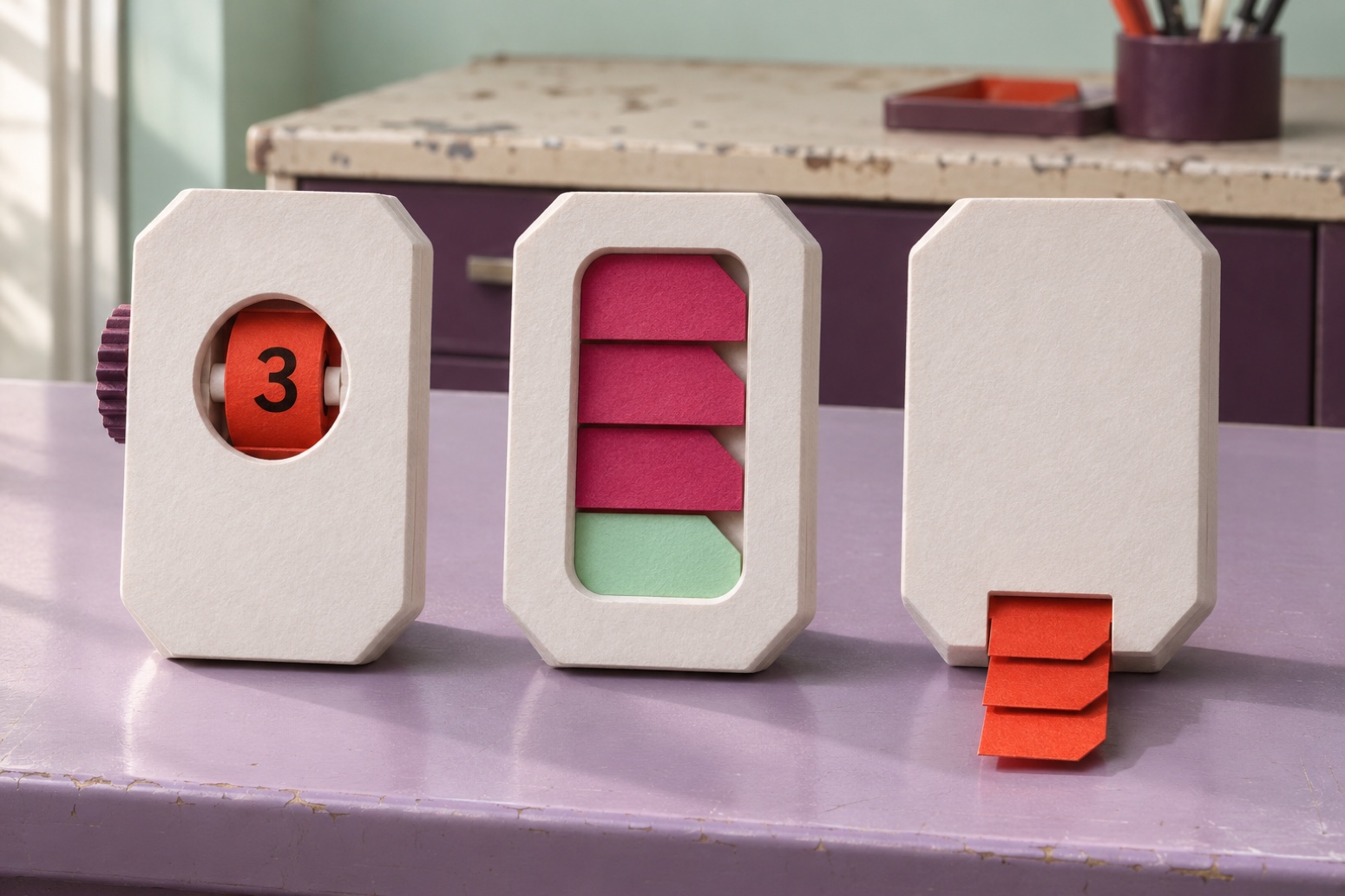
What would a queue ticket tell you if it counted only the people behind you? Start with a NONOBJECT, generate three speculative variants with AI, then take the question into the field. Use what people do to decide what to design.
One rule, three possible physical forms. AI-generated course study. Open the exercise ↗
Semester 2 · Summer semester5 CP · 150 hours overallStefan Kainbacher · HSRW2027 dates · To be confirmed
The semester project
Pick an everyday object with a rule you can break. Use your AI studies to uncover a question about people. Investigate it in a setting you can revisit, make competing proposals, build a prototype and change it after a test. Bring the decisions together in one illustrated process PDF.
Ask a participant to walk you through a recent experience. Record what they said and did. Compare your notes and identify a need that calls for a closer look.
Bring to synthesis Your challenge, impact ladder, audience map, interview notes and two additional Inspiration methods with reasons for choosing them.
Ideation
Write three ways of framing the same difficulty. Sketch alternatives. Make the smallest prototype that will let someone try the decision you are least certain about.
Bring to critique Stories, insights, How Might We questions, two additional Ideation methods, a journey, a storyboard and a prototype.
Implementation
Try the prototype with people affected by the design. Observe the outcome, revise and check again. Describe who would maintain the design and who might be excluded.
Complete the project Trial, revision, roadmap, resources, staffing, success measures, pitch and a five-to-ten-sentence reflection.
These phase names come from IDEO.org’s Design Kit. Move back to research whenever a test challenges an assumption. IDEO.org · Human-Centered Design
Worked example · Reframing a field observation
Read the pause.
Imagine a first-time visitor entering an open workshop. They pause at the door, look at the tables and wait for someone to speak.
What did they need at that moment? Choose one explanation. Notice how the question changes what you would make and what you would watch for.
Place a paper welcome marker at the first station. Show it from the doorway.
Observe
Ask someone to begin their visit. Record their first move and what they say they noticed.
Each explanation is a hypothesis. Ask the visitor what happened before choosing one for your project.
Plan your work
Ten online workshops and two studio days take the project from a provocation to a tested proposal. Open a presentation for teaching, a worksheet for project work, or a PDF for offline use. The 2027 teaching and submission dates will be announced separately.
By the end of 8226 you should be able to choose qualitative and quantitative research methods, translate findings into requirements, prototype and evaluate an experience. Show how your team considered competing stakeholder needs and the social or ethical consequences of a decision. Present your reasoning orally and in writing.
The module handbook allocates 150 hours, including 105 hours of self-study. Contact teaching comprises 30 teaching units of lectures and 30 of exercises. In the proposed schedule, the ten online workshops each provide three contact hours and the two studio days each provide seven and a half. This gives 45 contact hours, excluding breaks. The module has no entry requirements. The examination is graded. The examination board announces its components at the start of the semester.
Design Methods has its own project and submission. Module 8231, Interaction Design Basics, uses related methods for a fresh project about browser interaction. You can start it without bringing files from 8226.
Studio references
Look beyond the object
Branko Lukić and Barry M. Katz’s NONOBJECT (2010) asks what changes when a designer begins with the relationship between a person and an object. During your workshop visit, describe how the visitor relates to the space before sketching a new tool.
In IDEO.org’s Design Kit, read a method’s purpose, its participants and the steps. Set it beside your question and decide what evidence it could produce in the time available.
Place your current move in Discover, Define, Develop or Deliver. Compare it with IDEO.org’s three phases. Name one observation that could send you back to the field.
Use Don Norman’s distinction between possible actions and perceivable signifiers. Photograph the detail a newcomer could use and predict how it changes their first move.
 Start the first class